News
Memorial Day and a Brief Break
Everyone:
Thank you to everyone who participated in last weekend’s meeting. We heard you. We are rolling our sleeves and going back to work on a new budget.We also want to thank Juanita Starkey Lofton for her work as president of the board from last September to now. We wish her safe travels and hope that she and Elijah find happiness when they return to Massachusetts.But first, we are taking a break. All of us have obligations other than our board duties. Many of us are feeling a little burnt out. We will not be checking voicemail or email until Tuesday. We will not be meeting again until after the first of June.Once we have a date set, we will communicate it to you.Until then, please address any questions to our general email address (vivavillashoa@gmail.com) or leave a message on the board cell phone (727-427-5539. This number is replacing the 6046 number which will be going away in June.)We check messages and return them during business hours, Monday – Friday.Have a happy and safe Memorial Day, and we will see you in June.Meeting agenda / Agenda de la reunión – 05-16-2026
Apologies for the delay. We posted this to the physical bulletin board, but I completely forgot the digital dissemination.
(Disculpas por la demora. Publicamos esto en el tablón de anuncios físico, pero olvidé por completo la distribución digital.)
A Few Explanations
Many of our residents ask things like “what is this receivership the board keeps talking about,” or “why does it seem like only a few people make decisions.” Here’s an explanation.
Why This Conversation Matters
Our HOA is a legal corporation responsible for maintaining the community’s shared property and meeting state requirements. That includes the park, retention pond, basketball court, picnic tables, bulletin board, Little Free Library, insurance, taxes, and other legal and financial obligations.
An HOA cannot simply “pause” operations because volunteers are burned out or because homeowners are frustrated with dues increases. If the association becomes unable to function, the result can be court-ordered receivership.
What Is Receivership?
Receivership is a legal process where a judge appoints an outside person or company — called a receiver — to take control of the HOA.
The receiver temporarily replaces the elected Board of Directors and is given authority to operate the association.
This can happen if:
• There are not enough Board members to legally function
• Elections repeatedly fail
• No workable budget can be passed
• Bills and legal obligations cannot be paid
• The HOA becomes financially or operationally unstableReceivership is considered a last resort because it means the community loses local control.
What Happens During Receivership?
Once appointed by the court, the receiver takes over the association’s operations and finances.
The receiver may:
• Hire attorneys, accountants, and management companies
• Approve contracts and maintenance work
• Raise dues or impose special assessments
• Pursue collections more aggressively
• Manage legal compliance and insurance
• Make operational decisions without homeowner votingIn our community, the receiver would become responsible for:
• The commonly owned park
• The retention pond
• The basketball court
• Picnic tables and recreational areas
• The bulletin board
• The Little Free Library
• Insurance and state compliance
• Financial operations and collectionsThe receiver’s job is not to preserve community traditions or keep costs low. Their legal responsibility is simply to keep the HOA functioning and financially solvent.
Why Is Receivership Expensive?
Volunteer Board members are unpaid neighbors.
Receivers, attorneys, and court-appointed management professionals are not.
They bill the association for:
• Hourly legal work
• Property management services
• Administrative oversight
• Court reporting and compliance
• Collections and accounting work
• Maintenance coordinationFor a 229-home single-family community with shared property responsibilities and only about an 80% assessment collection rate, receivership costs could easily reach approximately $300–$900 per home, per year, depending on legal expenses, how long the receivership lasts, deferred maintenance needs, collection problems, and insurance and vendor costs.
Those costs are paid by homeowners.
That means homeowners could end up paying several times more than current dues while having substantially less control over community decisions.
“Only a Small Number of People Make Decisions Now.”
This concern is understandable, but it is also the reality of most volunteer organizations.
Board meetings are open. Homeowners are invited to attend meetings, ask questions, review budgets, volunteer, and run for the Board. The challenge is not that participation is forbidden — it is that participation is limited.
If more homeowners want a stronger voice in the community, the answer is greater involvement, not allowing the HOA to fail.
Receivership would reduce homeowner control even further because decisions would move from neighbors and volunteers to court-appointed outside professionals.
“We Already Pay $120 Per Year for Nothing.”
Current dues support more than visible amenities.
The HOA is legally responsible for:
• Common-area maintenance
• Retention pond obligations
• Liability insurance
• Legal filings and compliance
• Taxes and accounting
• Administrative operations
• Maintenance of shared infrastructureAt approximately $120 per year, our dues are already extremely low for a Florida HOA with commonly owned property.
A modest increase to maintain operations and avoid collapse is still far less expensive than receivership.
The Bottom Line
Receivership is not a reset button and it is not “free management.”
It is a court intervention that happens when a community can no longer govern itself.
The best way to avoid receivership is:
• Passing a workable budget
• Maintaining a functioning Board
• Supporting existing volunteers
• Encouraging additional homeowners to participate before burnout forces resignationsA volunteer Board may not be perfect, but it keeps decisions local, keeps costs lower, and allows homeowners to retain control of their own neighborhood.
Algunas Explicaciones
Por Qué Esta Conversación Es Importante
Nuestra HOA es una corporación legal responsable de mantener las propiedades compartidas de la comunidad y cumplir con los requisitos estatales. Eso incluye el parque, el estanque de retención, la cancha de baloncesto, las mesas de picnic, el tablón de anuncios, la Little Free Library, el seguro, los impuestos y otras obligaciones legales y financieras.
Una HOA no puede simplemente “poner en pausa” sus operaciones porque los voluntarios estén agotados o porque los propietarios estén frustrados por aumentos en las cuotas. Si la asociación deja de poder funcionar, el resultado puede ser una administración judicial ordenada por un tribunal.
¿Qué Es la Administración Judicial?
La administración judicial es un proceso legal en el cual un juez designa a una persona o empresa externa — llamada administrador judicial o “receiver” — para tomar control de la HOA.
El administrador judicial reemplaza temporalmente a la Junta Directiva elegida y recibe autoridad para operar la asociación.
Esto puede suceder si:
• No hay suficientes miembros de la Junta para funcionar legalmente
• Las elecciones fracasan repetidamente
• No se puede aprobar un presupuesto viable
• No se pueden pagar las facturas y obligaciones legales
• La HOA se vuelve financieramente u operacionalmente inestableLa administración judicial se considera un último recurso porque significa que la comunidad pierde el control local.
¿Qué Sucede Durante la Administración Judicial?
Una vez designado por el tribunal, el administrador judicial toma control de las operaciones y finanzas de la asociación.
El administrador judicial puede:
• Contratar abogados, contadores y empresas administradoras
• Aprobar contratos y trabajos de mantenimiento
• Aumentar cuotas o imponer evaluaciones especiales
• Cobrar pagos atrasados de manera más agresiva
• Manejar cumplimiento legal y seguros
• Tomar decisiones operativas sin votación de los propietariosEn nuestra comunidad, el administrador judicial sería responsable de:
• El parque de propiedad común
• El estanque de retención
• La cancha de baloncesto
• Las mesas de picnic y áreas recreativas
• El tablón de anuncios
• La Little Free Library
• El seguro y cumplimiento estatal
• Operaciones financieras y cobrosEl trabajo del administrador judicial no es preservar las tradiciones de la comunidad ni mantener bajos los costos. Su responsabilidad legal es simplemente mantener funcionando la HOA y asegurar que siga siendo financieramente solvente.
¿Por Qué Es Costosa la Administración Judicial?
Los miembros voluntarios de la Junta son vecinos no remunerados.
Los administradores judiciales, abogados y profesionales designados por el tribunal no lo son.
Ellos cobran a la asociación por:
• Trabajo legal por hora
• Servicios de administración de propiedades
• Supervisión administrativa
• Informes judiciales y cumplimiento
• Cobros y trabajo contable
• Coordinación de mantenimientoPara una comunidad de 229 viviendas unifamiliares con responsabilidades sobre propiedades comunes y una tasa de cobro de cuotas de aproximadamente el 80%, los costos de una administración judicial podrían alcanzar fácilmente entre aproximadamente $300 y $900 por vivienda al año, dependiendo de los gastos legales, la duración de la administración judicial, necesidades de mantenimiento atrasado, problemas de cobro, y costos de seguros y proveedores.
Esos costos son pagados por los propietarios.
Eso significa que los propietarios podrían terminar pagando varias veces más que las cuotas actuales mientras tienen considerablemente menos control sobre las decisiones de la comunidad.
“Solo Un Pequeño Número de Personas Toma Decisiones Ahora.”
Esta preocupación es comprensible, pero también es la realidad de la mayoría de las organizaciones voluntarias.
Las reuniones de la Junta son abiertas. Los propietarios están invitados a asistir a las reuniones, hacer preguntas, revisar presupuestos, ofrecerse como voluntarios y postularse para la Junta. El problema no es que la participación esté prohibida, sino que la participación es limitada.
Si más propietarios desean tener una voz más fuerte en la comunidad, la respuesta es una mayor participación, no permitir que la HOA fracase.
La administración judicial reduciría aún más el control de los propietarios porque las decisiones pasarían de vecinos y voluntarios a profesionales externos designados por el tribunal.
“Ya Pagamos $120 al Año por Nada.”
Las cuotas actuales apoyan más que las comodidades visibles.
La HOA es legalmente responsable de:
• Mantenimiento de áreas comunes
• Obligaciones relacionadas con el estanque de retención
• Seguro de responsabilidad civil
• Presentaciones legales y cumplimiento
• Impuestos y contabilidad
• Operaciones administrativas
• Mantenimiento de infraestructura compartidaCon aproximadamente $120 al año, nuestras cuotas ya son extremadamente bajas para una HOA en Florida con propiedad común.
Un aumento moderado para mantener las operaciones y evitar el colapso sigue siendo mucho menos costoso que una administración judicial.
La Conclusión
La administración judicial no es un botón de reinicio y no es “administración gratuita.”
Es una intervención judicial que ocurre cuando una comunidad ya no puede gobernarse a sí misma.
La mejor manera de evitar la administración judicial es:
• Aprobar un presupuesto viable
• Mantener una Junta Directiva funcional
• Apoyar a los voluntarios actuales
• Motivar a más propietarios a participar antes de que el agotamiento provoque renunciasUna Junta voluntaria puede no ser perfecta, pero mantiene las decisiones a nivel local, mantiene costos más bajos y permite que los propietarios conserven el control de su propio vecindario.
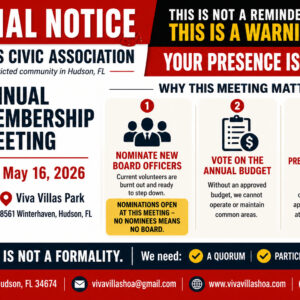
AVISO OFICIAL – REUNIÓN ANUAL DE MIEMBROS
AVISO OFICIAL
Esto no es un recordatorio. Esto es una advertencia.
SU PRESENCIA
ES OBLIGATORIA.
REUNIÓN ANUAL DE MIEMBROS
Sábado, 16 de mayo de 2026
12:00 PM • Viva Villas Park
POR QUÉ IMPORTA ESTA REUNIÓN
- NOMINAR NUEVOS DIRECTIVOS Los voluntarios actuales están agotados y listos para retirarse. Las nominaciones se abren en esta reunión — sin candidatos no hay junta directiva.
- VOTAR EL PRESUPUESTO ANUAL Sin un presupuesto aprobado, no podemos operar ni mantener las áreas comunes.
- EVITAR LA ADMINISTRACIÓN JUDICIAL Si no podemos gobernarnos, un tribunal NOMBRARÁ un administrador externo a un costo significativo para cada dueño de vivienda.
Esto no es una formalidad. Necesitamos quórum. Necesitamos SU presencia.
¿No puede asistir a la reunión? Descargue el formulario de poder notarial aquí:
ANNUAL MEETING – YOUR COMMUNITY NEEDS YOU
Dear Viva Villas Neighbors,
This is your official notice of the Viva Villas Annual Membership Meeting.
 Saturday, May 16, 2026
 12:00 PM
 Viva Villas Park (8561 Winterhaven, Hudson, FL)
This is not a routine meeting. Your participation is necessary to ensure the continued operation of the association.
Key items on the agenda include:
- Election of Board Members
- Approval of the Annual Budget
- Ongoing governance of the association
Current board volunteers are stepping down. Without new members, the association cannot function.
Without an approved budget, we cannot maintain common areas or operate.
If we cannot govern ourselves, a court may appoint a receiver to manage the association at significant cost to all homeowners.A quorum is required to conduct business. Your attendance—or submission of a valid proxy if you cannot attend—is essential.
Please review the attached notice for full details.
Thank you for your prompt attention to this matter.
Viva Villas Civic Association
P.O. Box 6008
Hudson, FL 34674
 vivavillashoa@gmail.com
 www.vivavillashoa.com
 (727) 427-6046
NOTE: If you cannot attend the meeting please complete and return the attached proxy form.
Viva_Villas_Proxy_Fillable_v2Happy Spring Holidays
The Board will be taking today and Monday off. Look for minutes from last week’s board and general meetings after Tuesday.
In the meantime, Chag Pesach Sameach to those observing that holiday, Happy Easter to those observing that holiday, and happy Spring to everyone.
If you need anything you can leave a detailed message on the board cellphone: 727-427-6046 or email vivavillashoa@gmail.com and we’ll respond next week.
28 March 2026 – General Meeting – Agenda
Opening
Date: 28 March 2025
Location: Viva Villas Park ( 8561 Winterhaven Dr.)
Start Time:Call to Order and Roll Call:
Via Sign-in Sheet.AGENDA ITEMS:
Project Updates:
– Basketball Court
– Community Maintenance (Trees, Park Signs)
– Electrical and fountain.Admin Updates:
– Insurance
– Computer
– Phone: (727) 427 – 6046
– Document revision & Document preservation
– Violation Letters
– Current FinancesAction Items:
– Budget
– Property Management — > Software Suite plus Accountant.
– Violation enforcement
– Community must step up.Administrative Detail
NEXT MEETINGS: Boad: Community:
Adjourn:Assessment Update
To date, nearly 70%of Viva Villas residents have paid their annual dues totalling $120($12/month).Thank you to those who have paid. To those who have not paid, late notices will be mailed.If you are uncertain that you’ve paid, please check your bank statement. All dues checks received as of 2/13/2026_have been deposited to the Viva Villas Civic Association, Inc. account at Wells Fargo bank. These dues cover requisite expenses of insurance and Community Park maintenance as well as a newly required bulletin board, among other expenses.Further, our community members requested installation of a basketball court as well as restoration of electrical power to the Community Park.These projects, among others, are in process.If you have not paid your dues, please do so. They are needed by our Community!